
Key facts: Refrigerant Leak Repair
- Refrigerant circulates in a closed loop; a low charge means a leak.
- Technicians who handle refrigerant must be certified under EPA Section 608 [1].
- Production of R-22 for servicing ended in 2020 under federal phaseout rules [1].
- Federal rules under the AIM Act are phasing down high-GWP HFC refrigerants [2].
- Long line sets and flare fittings on mini-splits are common leak points.
The problem
Why refrigerant leaks matter
Refrigerant is the working fluid that carries heat out of your home. When some escapes, the system has less capacity to absorb heat from indoor air. Cooling weakens, the compressor runs longer and hotter, and the indoor coil can get so cold that it freezes. Left alone, a leak can lead to a damaged compressor, the hardest component to replace.
Leaks also matter beyond your home. Many refrigerants are powerful greenhouse gases, and older ones such as R-22 also damage the ozone layer. That is why federal rules control who can handle refrigerant, how it is recovered and how leaks are repaired.
Signs
Signs of a refrigerant leak
Weak or warm air
The system runs but cannot keep the house cool.
Ice on lines or the coil
Low charge makes the coil too cold.
Hissing or bubbling
Sometimes audible near the leak.
Long run times
The system struggles to reach the set temperature.
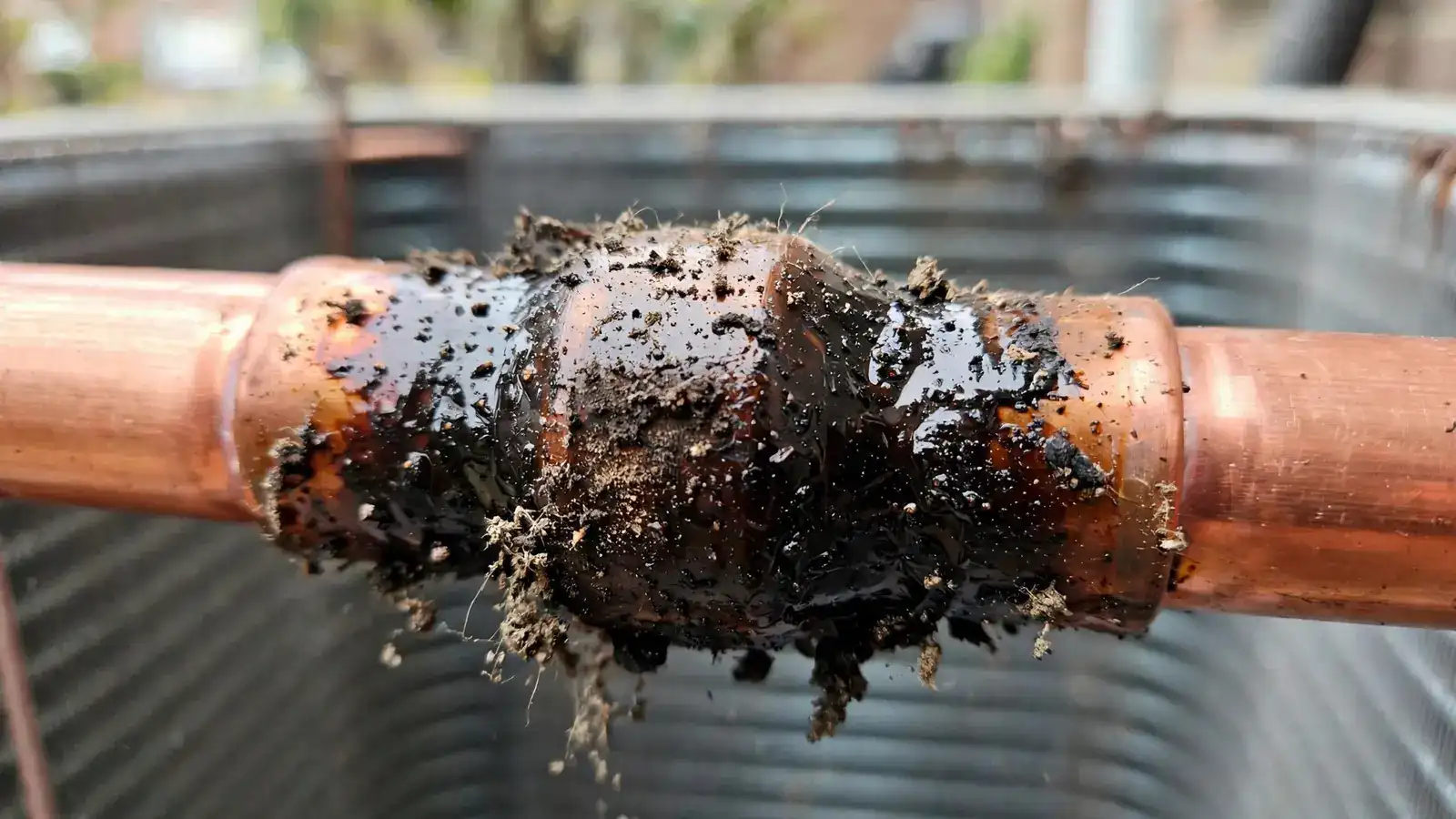
Oily residue at joints
Refrigerant carries oil that stains where it escapes.
Recharged before
If it needed refrigerant last year, it is still leaking.
Leak detection
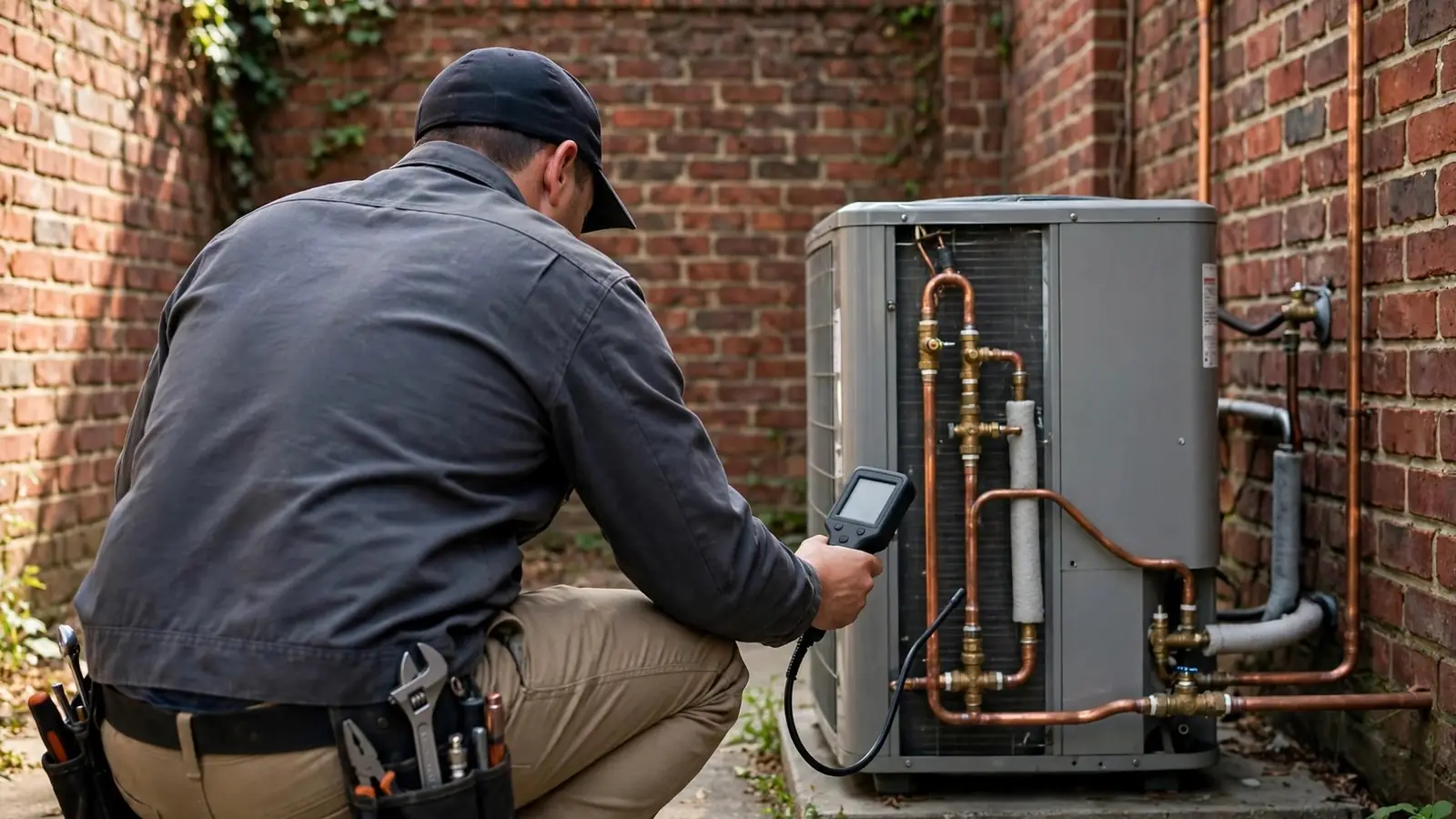
How technicians find leaks
Finding the leak is the hardest part of the job, and the most important.
- 1
Check pressures and temperatures
Readings confirm whether the charge is low.
- 2
Visual inspection
Oil stains, corrosion and damaged insulation on lines and joints.
- 3
Electronic detector
A sensor sniffs for refrigerant along lines and coils.
- 4
Bubble solution
Soapy liquid on suspect joints shows escaping gas.
- 5
UV dye
Dye added to the system glows at the leak under UV light.
- 6
Nitrogen pressure test
After recovering refrigerant, the system is pressurized to locate and confirm leaks.
Leak points
Where leaks usually happen
| Location | Why | Usual repair |
|---|---|---|
| Indoor evaporator coil | Corrosion over time | Repair if possible, or coil replacement |
| Outdoor condenser coil | Corrosion, damage, vibration | Repair or coil replacement |
| Flare fittings on mini-splits | Loose or poorly made joints | Remake the flare |
| Long rooftop line sets | Vibration, chafing, old joints | Repair or replace section |
| Service valves and Schrader cores | Worn seals | Replace core or cap |
| Brazed joints | Poor original brazing | Rebraze |
Refrigerant types
R-22, R-410A and newer refrigerants
Many older DC systems, especially those installed before 2010, use R-22. R-22 production for servicing ended in 2020, so only recovered and reclaimed supplies remain. Repairing an R-22 leak is still possible, but the limited refrigerant and the age of these systems often lead owners to consider replacement. Systems installed in the 2010s and early 2020s mostly use R-410A.
Under the AIM Act, federal rules are phasing down high-global-warming-potential HFCs such as R-410A. [2] New systems now use lower-impact refrigerants, often classed as A2L, which need technicians trained in their handling. Existing R-410A systems can continue to be serviced. A technician can tell you what your system uses and what that means for repairs.
Line sets
Line sets in DC rowhouses
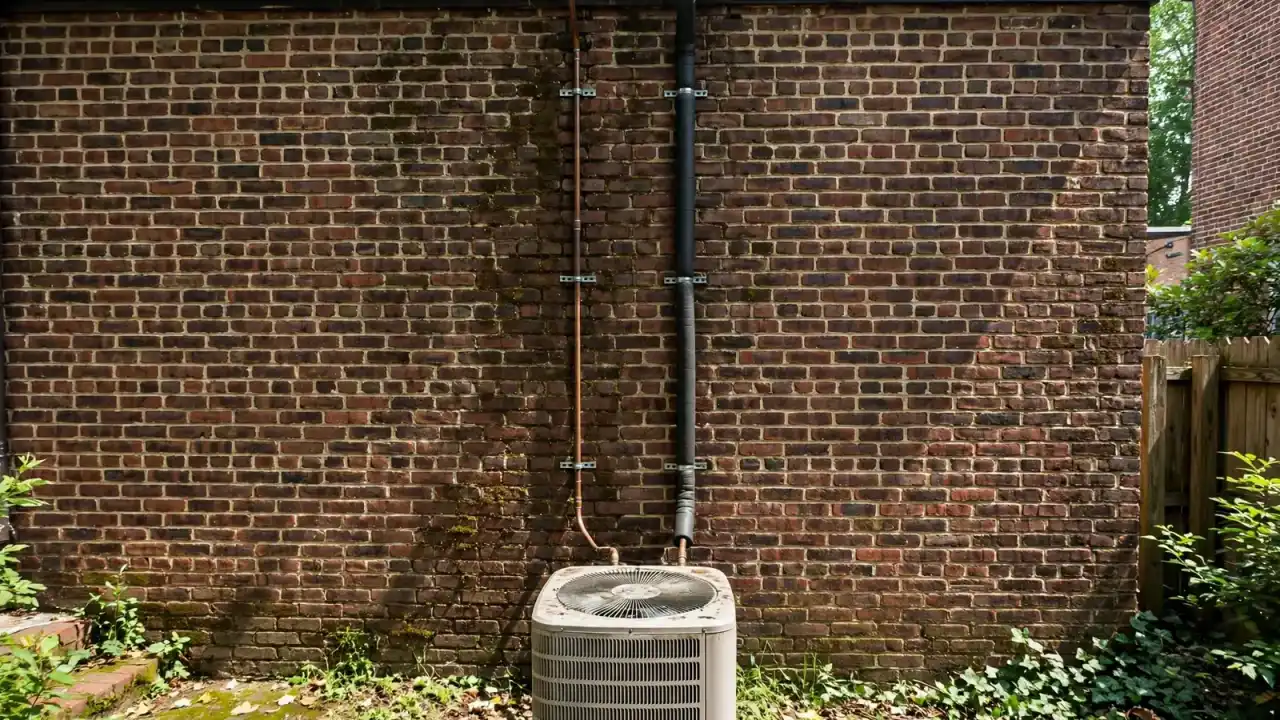
When a condenser sits on a rowhouse roof and the air handler is in the basement or a closet, the refrigerant line set may run three or four stories, through closets, chases or along an exterior wall. Long runs have more joints, more places for vibration to chafe the copper, and more insulation that can degrade in the sun. Leaks in these lines can be hard to reach. Technicians may need to open closet walls or work from the roof. Sometimes replacing a section, or the entire line set, is the most reliable fix.
Mini-splits
Ductless mini-splits and leaks
Ductless mini-splits are popular in DC rowhouses and condos because they avoid running ducts through old walls. Each indoor head connects to the outdoor unit with its own line set, joined with flare fittings. If a flare is not made or tightened correctly, it can leak slowly for months.
Leak checks on mini-splits focus on the flare joints at the indoor head and outdoor unit. Remaking a flare is often a straightforward repair once the leak is found. Indoor heads should also be checked for coil leaks and drain problems.
- Flare joints are common leak points
- Each head has its own line set
- Slow leaks show up as weak cooling
- Repairs often involve remaking flares
- Check drains while you are at it
Recharge and test
After the repair
Once a leak is repaired, the technician evacuates the system with a vacuum pump to remove air and moisture, then charges it with the correct amount of refrigerant, usually by weight according to the manufacturer's specifications and line length. They then run the system and check pressures, temperatures and superheat or subcooling to confirm the charge is right. Ask for a note of what was repaired, how much refrigerant was added and the readings after the repair.
Decisions
Repair or replace after a leak
| Factor | Leans toward repair | Leans toward replacement |
|---|---|---|
| System age | Under about ten years | Old and worn |
| Refrigerant | R-410A or newer | R-22 |
| Leak location | Accessible joint or valve | Evaporator coil with corrosion |
| History | First leak | Repeated leaks |
| Comfort | Cooled well before | Never kept up |
More help
Where to read next
AC not cooling
Other causes of weak cooling.
Read moreFrozen coil
Low charge can cause ice.
Read moreHeat pump repair
Leaks affect heating too.
Read moreAC installation
If replacement makes sense.
Read more
The basics
How a refrigerant circuit works
Inside the sealed loop, the compressor squeezes refrigerant gas, raising its pressure and temperature. In the outdoor condenser coil, the hot gas gives off heat to outside air and condenses into a liquid. The liquid passes through a metering device, where its pressure drops suddenly, making it very cold. In the indoor evaporator coil, it absorbs heat from the air your blower pushes across it and boils back into a gas, which returns to the compressor to start again.
Each part of this loop depends on the right amount of refrigerant. Too little and the evaporator runs too cold at first, then starves; the compressor overheats because returning gas also cools it. Too much and pressures climb, efficiency falls and the compressor can be damaged by liquid. That is why technicians charge systems carefully and why leaks should be fixed, not just refilled.
Coil leaks
Corrosion in indoor coils
Many leaks in systems over about eight to ten years old come from tiny pinholes in the copper tubing of the indoor evaporator coil. These are often caused by formicary corrosion, a reaction between copper, moisture and certain household chemicals that slowly eats microscopic tunnels through the tube walls. Air fresheners, cleaning products and building materials can contribute. These leaks are slow and hard to pinpoint. When they are found, options include replacing the coil or, depending on age and refrigerant, considering a new system.
The visit
What to expect during a leak repair visit
- 1
Confirm the problem
Pressures, temperatures and airflow are checked.
- 2
Search for the leak
Inspection, detectors, bubbles or dye.
- 3
Recover refrigerant
Removed safely into a recovery cylinder if the system must be opened.
- 4
Repair
Rebraze, remake flares, replace valves, sections or coils.
- 5
Pressure and vacuum test
Confirm the repair holds and remove moisture.
- 6
Recharge and verify
Weigh in refrigerant and confirm performance.
Methods
Leak detection methods compared
| Method | Good for | Limits |
|---|---|---|
| Visual and oil stains | Obvious leaks at joints | Misses slow or hidden leaks |
| Electronic detector | Scanning lines and coils | Wind and cleaners can confuse it |
| Bubble solution | Pinpointing a suspected joint | Slow on large areas |
| UV dye | Intermittent or hidden leaks | Takes time to show |
| Nitrogen pressure test | Confirming leaks and repairs | System must be opened |
Rooftops
Leaks on rooftop units
Rooftop condensers in DC face strong sun, heat, rain and wind, plus the occasional foot traffic from roofers or other trades. Line set insulation breaks down in UV light, exposing copper to moisture. Lines resting on rough roofing can chafe. Condensers on vibration pads that have shifted can stress joints. A technician checking a rooftop system looks along the whole run: the condenser coil, service valves, the line set where it leaves the unit, where it enters the building, and any visible joints inside.
Heat pumps
Heat pumps and refrigerant
Heat pumps use the same refrigerant loop to cool in summer and heat in winter, with a reversing valve switching the direction of flow. A leak therefore affects both seasons. Heat pumps also have more parts that can leak, including the reversing valve and extra valves. Low charge in winter can lead to poor heating and more reliance on backup electric heat. See our heat pump repair page for more.
Questions
Questions to ask about a leak repair
- Where exactly was the leak?Ask to see it or a photo.
- What refrigerant does my system use?Affects repair options.
- How was the repair confirmed?Pressure test or leak check after repair.
- How much refrigerant was added?Written down for your records.
- Are there likely to be other leaks?Older coils may have more than one.
Top-ups
Why recharging alone is not a fix
It can be tempting to have a system topped up each spring and carry on. But each recharge only replaces what has already leaked, and the leak keeps going. Over time, the system runs low more often, comfort suffers, the compressor works harder and more refrigerant ends up in the atmosphere. Federal rules also require leak repairs on larger systems that exceed certain leak rates. For home systems, the practical advice is the same: find and fix the leak, then recharge once.
After service
Signs the charge is wrong after work
If a system was recently serviced and still cools poorly, short cycles, ices up or makes unusual noise, the charge may be off, or another problem may remain. Overcharging is as harmful as undercharging. Ask the technician to come back and check pressures and temperatures. Keep the notes from each visit so the next technician can see what was done.
Summary
Refrigerant at a glance
| Refrigerant | Typical systems | Status |
|---|---|---|
| R-22 | Older systems, often pre-2010 | Production ended; reclaimed supply only |
| R-410A | Most systems from about 2010 to early 2020s | Being phased down; still serviced |
| A2L refrigerants (e.g. R-454B, R-32) | New systems | Lower global warming impact; mildly flammable classification |
Prevention
Keeping your system leak-free
- 1
Keep the outdoor unit clean and level
Reduces stress on joints and coils.
- 2
Protect line set insulation
Replace cracked or missing insulation.
- 3
Avoid harsh chemicals near the indoor coil
Some can contribute to corrosion.
- 4
Schedule regular checks
Technicians can spot early oil stains or damage.
- 5
Keep records
A history of recharges reveals slow leaks.
Timing
Leaks and DC's summer peaks
Slow leaks often go unnoticed through spring and fall, then show up on the first hot week in June, when the system cannot keep up. By July, technicians are busiest. A spring check, where pressures and temperatures are measured before the heat arrives, can catch a slow leak early. If your system struggled at the end of last summer, mention it during a spring visit.
Rules
Older systems and environmental rules
Federal rules under Section 608 of the Clean Air Act prohibit knowingly venting refrigerant and require technicians to recover it during service and disposal. When an old system is removed, its refrigerant must be recovered before the equipment is scrapped. If you replace a system, ask how the old refrigerant will be handled. DC's Department of Energy and Environment also works on climate and refrigerant issues locally.
Records
What a good leak repair report includes
Leak location
Which joint, coil or valve.
Repair method
Rebrazed, flare remade, part replaced.
Test method
Nitrogen pressure, vacuum hold or detector.
Refrigerant type and amount
What was added, by weight.
Readings after repair
Pressures, temperatures, superheat or subcooling.
Recommendations
Any other concerns found.
Outdoor coils
When the leak is in the outdoor coil
Outdoor condenser coils can leak from corrosion, damage from hail or debris, or vibration where tubes touch. On rooftop units, coils also face harsh sun and heat. Small leaks can sometimes be repaired; extensive corrosion usually means coil or unit replacement. Keeping the coil clean and the unit level helps it last longer.
Hidden lines
Leaks inside walls and closets
When a line set runs inside a wall, closet or chase, a leak there can be the hardest to find and reach. Technicians may first rule out the coils, valves and visible joints, then pressure-test sections of the line to narrow down the location. In some DC rowhouses, running a new line set along a different route, such as an exterior chase or a rear wall, is simpler than opening finished walls. If a new route would be visible from the street in a historic district, ask whether review is needed.
Safety
Refrigerant leaks and indoor air
Most residential refrigerants are not toxic in the small amounts that leak slowly from a home system, but refrigerant can displace oxygen in an enclosed space if a large amount escapes, and newer A2L refrigerants are classed as mildly flammable. If you hear loud hissing, notice a strong chemical smell, or a line is visibly damaged, switch off the system, ventilate the area and call a technician. Keep open flames and sparks away from a suspected large leak.
Renters
Renters and refrigerant leaks
If you rent in DC and your cooling has weakened, tell your landlord in writing. Repairs to building-supplied air conditioning are generally the landlord's responsibility, and the landlord or property manager arranges the technician. Describe what you have noticed, such as weak air, ice on lines or a hissing sound, and give access for the repair.
FAQ
Refrigerant leak questions
Does an AC need refrigerant topped up every year?
No. Refrigerant is not used up; needing more means a leak.
Can I recharge my AC myself?
No. Refrigerant handling requires EPA Section 608 certification.
Are stop-leak products a good idea?
Usually not. They can clog parts; ask a technician first.
Is my R-22 system still repairable?
Often, but refrigerant supplies are limited, so many owners weigh replacement.
How long does leak detection take?
Simple leaks can be found quickly; hidden leaks in long line sets take longer.
Is a refrigerant leak dangerous?
In homes, small leaks are mainly a performance and environmental issue; ventilate and call a technician if you notice a strong odor or hissing.
Can a mini-split leak at the wall unit?
Yes, often at the flare joint. Remaking the flare usually fixes it.
Why is there ice on my refrigerant line?
Low charge or low airflow can make lines and coils freeze.
Do newer refrigerants need special technicians?
Many new systems use A2L refrigerants that require specific training.
Will fixing the leak restore cooling?
If the leak was the only problem, yes, after a proper recharge.
What causes pinhole leaks in indoor coils?
Often formicary corrosion, a slow chemical reaction in copper tubing.
Does a heat pump leak affect heating too?
Yes. The same refrigerant loop heats and cools.
Can line set insulation cause leaks?
Degraded insulation exposes copper to moisture and damage, which can lead to leaks.
Is it harmful to overcharge an AC?
Yes. Too much refrigerant raises pressures and can damage the compressor.
Do I need building permission for a rooftop repair in my condo?
Often. Check with management about roof access and contractor rules.
Does venting refrigerant break the law?
Knowingly venting most refrigerants violates federal rules. Technicians must recover it.
Should I open windows if I suspect a refrigerant leak?
If you hear hissing or smell chemicals, switch off the system, ventilate and call a technician.
Can a leak be inside my wall?
Yes, where line sets run through walls or closets. Technicians narrow it down with pressure tests.
Who arranges a leak repair in a rental?
Repairs to landlord-supplied equipment are generally the landlord's responsibility. Report problems in writing.
How long does a recharge take after the repair?
Often an hour or two, including vacuum and testing.
Can a leak come back after repair?
A repaired joint should hold, but older coils can develop new pinholes over time.
Why does my technician weigh the refrigerant?
Charging by weight ensures the system gets the amount the manufacturer specifies.
Does a leak make my energy use go up?
Usually. A system low on refrigerant runs longer to reach the set temperature.