
Key facts: AC blowing warm air
Start here
Five-minute checks
Many warm-air calls end here.
- 1
Thermostat mode
Set to Cool, not Heat or Fan only.
- 2
Fan setting
Auto, not On; On blows air even when cooling stops.
- 3
Setpoint
A few degrees below the room temperature.
- 4
Filter
Replace if dirty.
- 5
Outdoor unit
Is the fan turning and is it humming?
- 6
Breakers
Reset once if tripped.
Outdoor unit
If the outdoor unit is not running
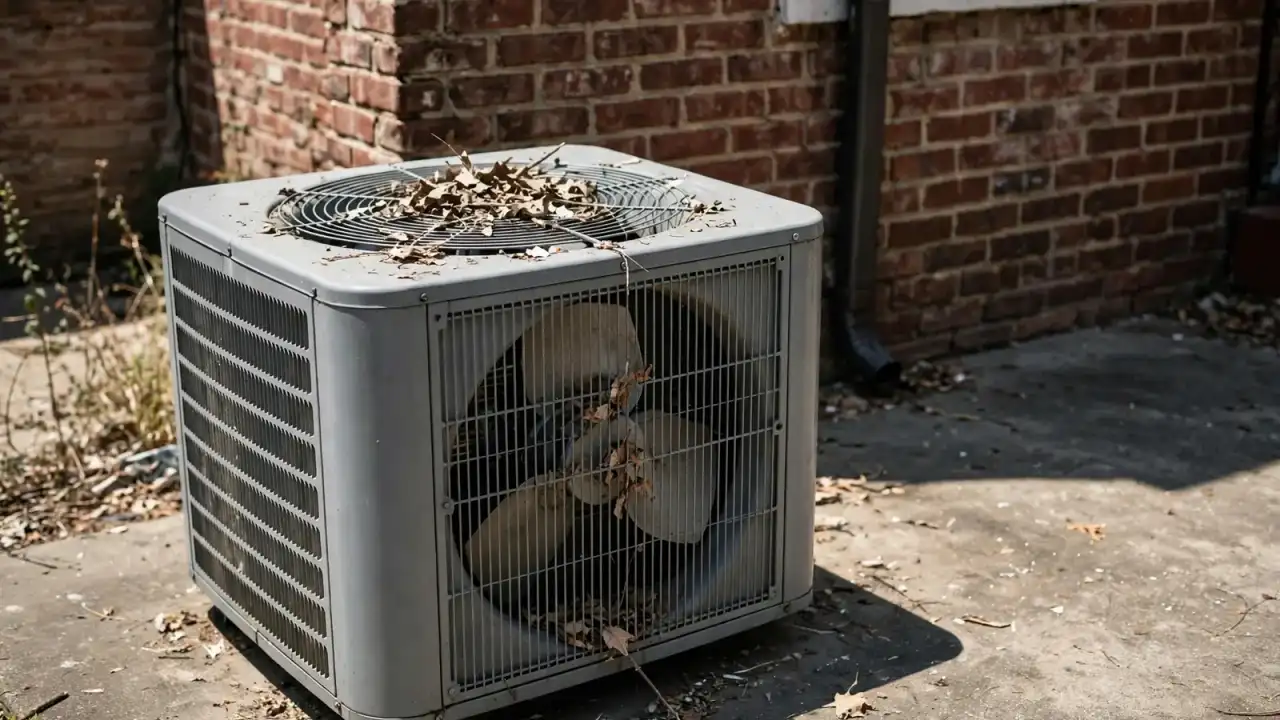
If the indoor fan runs but the outdoor unit is silent, the outdoor unit is not getting power or a signal. Check the outdoor breaker and the disconnect box near the unit. If the unit hums but the fan does not turn, a failed capacitor or fan motor is likely; switch the system off to protect the compressor. If the outdoor unit runs but the air indoors is still warm, the problem is more likely refrigerant, a compressor issue or a reversing valve on a heat pump.
What it means
Finding and meaning
| You find | Usually means |
|---|---|
| Thermostat on Heat or Fan only | Setting; switch to Cool |
| Very dirty filter | Low airflow; replace and watch |
| Outdoor unit silent | Power, breaker or control problem |
| Outdoor unit hums, fan still | Capacitor or fan motor |
| Outdoor runs, air warm | Refrigerant or compressor problem |
| Ice on lines | Low airflow or low refrigerant |
Heat pumps
Heat pumps blowing warm air in summer
If you have a heat pump, warm air in summer can mean the reversing valve is stuck in heating mode or the thermostat is set to Heat or Auto with a high setpoint. Check the thermostat first. If settings are correct and the outdoor unit runs, a technician can test the reversing valve and its solenoid.
Calling
When to call
If the simple checks do not restore cooling, call. Describe what you found: whether the outdoor unit runs, any sounds, ice or water, and what you already tried. That helps the technician come prepared. Our pages on AC not cooling and capacitor and fan repair cover the most common causes in more detail.
Normal operation
How cooling is supposed to feel
On a working central system, air from supply vents is usually about 15 to 20 degrees Fahrenheit cooler than the air going into the return grille, once the system has run for ten minutes or so. A simple kitchen thermometer held in a vent and near a return can give a rough idea. If the difference is small, cooling is not happening properly. On very humid days, the difference may be a little smaller because the system spends more effort removing moisture.
Rowhouse layouts
Rowhouses and the top floor
In DC rowhouses, the top floor often feels warm even when the system works, because flat roofs absorb sun and heat rises. Air from top-floor vents may feel less cool if ducts run through hot attic spaces or are leaky. If only the top floor is warm while lower floors are cool, ducts, insulation or zoning may be the issue rather than a failed system. A technician can measure temperatures at each vent.
Less obvious causes
Other reasons air feels warm
Leaky return duct
Pulls hot attic or basement air into the system.
Disconnected supply duct
Cool air dumps into a wall or attic.
Grimy indoor coil
Cannot absorb heat well.
Wrong blower speed
Too fast for good cooling in humid weather.
Undersized system
Cannot keep up on the hottest days.
Sunny rooms
Large west-facing windows add heat.
When you call
What to tell the technician
- 1
When it started
Sudden or gradual?
- 2
What the outdoor unit does
Running, humming, silent?
- 3
Any ice or water
Indoors or on lines.
- 4
What you checked
Thermostat, filter, breakers.
- 5
System type
Central AC, heat pump or mini-split.
Mini-splits
Mini-splits blowing warm air
If a ductless mini-split head blows warm air, check the remote's mode setting (cool, not heat, fan or auto with a high setpoint), clean the head's filters and look for a blinking light or error code. If the outdoor unit is not running, check its breaker. Many mini-splits pause cooling briefly to protect the compressor or during startup. Persistent warm air with the outdoor unit running often points to low refrigerant from a flare joint leak.
After outages
Warm air after a power outage
After a power cut, some systems take a few minutes to restart the outdoor unit because of built-in delays that protect the compressor. During that time, the indoor fan may blow room-temperature air. Wait five to ten minutes. If the outdoor unit still does not start, check its breaker, since surges when power returns can trip it. Storm surges can also damage capacitors and control boards.
Safety
Safe habits while troubleshooting
- Do not open unit panelsHigh voltage inside.
- Reset breakers onceRepeated trips mean a fault.
- Keep away from moving fansNever reach into the outdoor unit.
- Do not add refrigerantCertified technicians only.
Older systems
Older systems and warm air
Systems more than fifteen years old, especially those using R-22, are more prone to leaks, worn compressors and failing coils. Warm air from an older system may still be a simple fix such as a capacitor, but if the cause is a major component, a technician can explain repair and replacement options.
FAQ
Warm air questions
Why is my AC blowing warm air after I changed the thermostat?
It may be wired or set up incorrectly, especially for a heat pump.
Can a dirty filter cause warm air?
It can reduce airflow and cause the coil to freeze, which leads to warm air.
Is warm air from one vent normal?
One warm vent may point to a duct problem rather than the system.
Should I keep running the AC if it blows warm air?
If the outdoor fan is stopped or there is ice, no. Turn it off.
How cold should air from my vents be?
Usually about 15 to 20°F cooler than the air entering the return.
Why is only my top floor warm?
Heat gain under the roof, leaky ducts or zoning can be the cause.
Why does my mini-split blow warm air?
Check the mode setting and filters, then look for error codes.
Why does my AC blow warm air right after it starts?
Some systems delay the outdoor unit for a few minutes to protect the compressor.
Is warm air always a major problem?
No. Many causes, such as filters, breakers and capacitors, are simple fixes.