

Key facts: Capitol Hill
- The Capitol Hill Historic District ranks among the biggest protected historic areas anywhere in the country [1].
- Most homes are rowhouses built between roughly 1870 and 1930.
- Many central systems have rooftop condensers and long refrigerant runs to basement or closet air handlers.
- Changes visible from the street in historic districts may need review by DC's Historic Preservation Office.
- The covered ZIP codes for Capitol Hill on this line are 20002 and 20003.
Coverage
Capitol Hill ZIP codes served
Calls from these Capitol Hill ZIP codes can reach an independent HVAC technician who works there.
- 20003Southern Capitol Hill, Eastern Market, Barracks Row and the streets toward the Navy Yard.
- 20002Northern and eastern Capitol Hill, H Street and the blocks toward Lincoln Park and beyond.
About Capitol Hill
A neighborhood of rowhouses
Capitol Hill grew east of the Capitol through the nineteenth century, filling with rowhouses for government workers, craftsmen and families. Today its blocks of Italianate, Queen Anne and Romanesque rowhouses, painted brick fronts, bay windows and iron stoops make it one of Washington's best-known residential neighborhoods. Eastern Market, a working market since the 1870s, anchors its southern side.
Most houses are two or three stories plus a basement, narrow and deep, sharing party walls with neighbors. Roofs are typically flat or low-slope behind a decorative cornice. Many have been renovated repeatedly, with English basement apartments, rear additions and roof decks.
Typical setups
How cooling was added to Capitol Hill rowhouses
Rooftop condenser
Outdoor unit on the flat roof, out of street view.
Basement air handler
Ducts run up through closets and chases.
Top-floor air handler
In a crawl space or closet under the roof.
Two systems
One for lower floors, one for upper floors.
Ductless mini-splits
Common in renovations and basement units.
Window units
Still found in older rentals and some floors.
Rooftops
Rooftop condensers and roof access
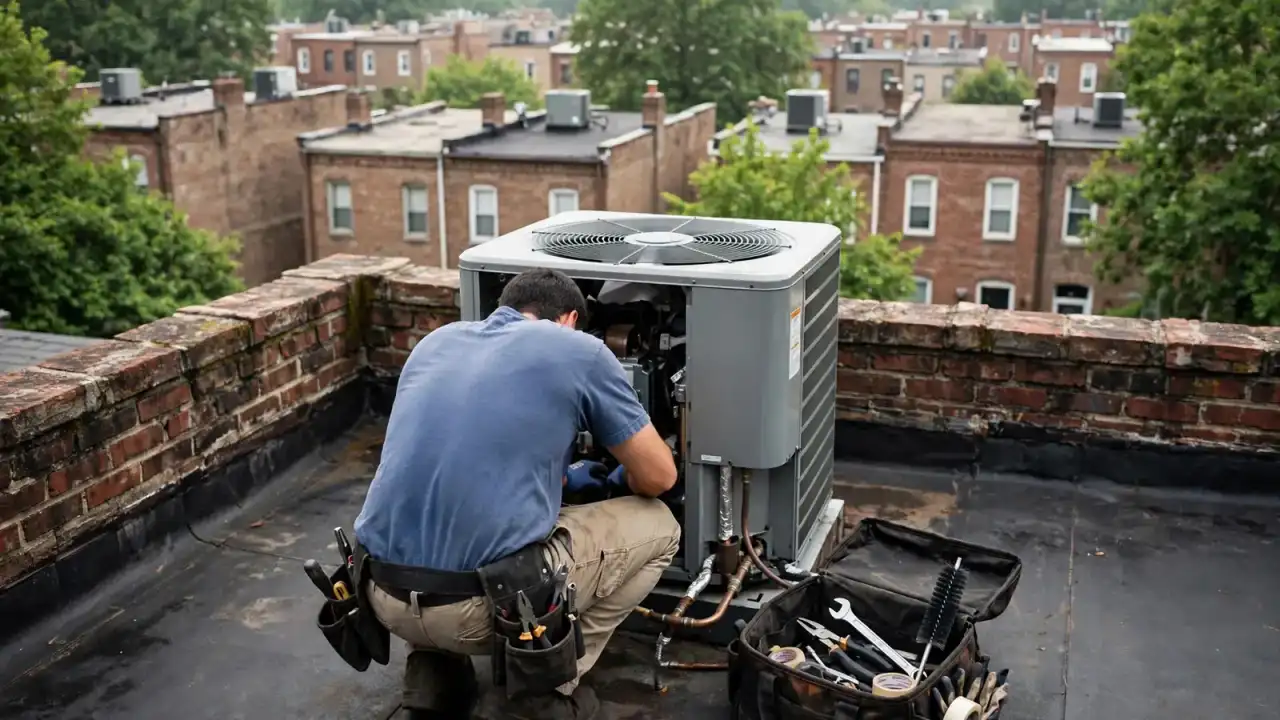
On Capitol Hill, condensers usually sit on the main roof, often near the back so they are not visible from the street. Technicians reach them through roof hatches, often via a ladder in a top-floor closet, or occasionally from a neighboring roof. Dark, flat roofs get extremely hot in summer, which adds stress to capacitors, fan motors and compressors. Units collect leaves from street trees and debris blown across rooftops.
When you call, mention how the roof is reached, whether the hatch is easy to open, and whether there is a roof deck or other equipment nearby. Technicians are careful to protect roofing membranes when carrying parts and tools.
Problems
Common Capitol Hill AC problems
| Problem | Why it happens here | Usual fix |
|---|---|---|
| Weak cooling on top floor | Roof heat gain, long duct runs | Duct sealing, zoning or a second system |
| Refrigerant leak | Long line sets, old joints | Find and repair, then recharge |
| Fan stopped on roof unit | Heat-stressed capacitor or motor | Replace capacitor or motor |
| Water in basement | Clogged condensate drain or pump | Clear drain, replace pump |
| Ceiling stain on top floor | Attic air handler pan overflow | Clear drain, add safety switch |
| Mini-split error codes | Sensors, leaks or drains | Diagnose and repair |
Line sets
Long refrigerant line sets
With the condenser on the roof and the air handler in the basement, refrigerant lines may run three stories or more through closets, chases or along a rear wall. These long runs have more joints, more insulation to degrade and more chances for leaks. A slow leak shows up as gradually weakening cooling. Technicians check pressures and temperatures, inspect accessible joints and insulation, and use electronic detectors or nitrogen tests to locate leaks. Sometimes running a new line set along a better route is simpler than chasing an old leak.
Before you call
First checks for a Capitol Hill system
- 1
Thermostat
Cool mode and a sensible setpoint.
- 2
Filter
Often at the basement or closet air handler.
- 3
Breakers
Indoor and outdoor units have separate breakers.
- 4
Roof unit
If safe, see whether the fan is spinning.
- 5
Basement drain
Look for water around the air handler or pump.
- 6
Top-floor ceiling
Check for stains below an attic unit.
Basement units
English basements and rental units
Many Capitol Hill rowhouses have English basement apartments with their own entrance. These often have separate cooling, frequently a ductless mini-split or a small split system, and separate thermostats. Basement units deal with humidity, and their condensate may need a pump.
If you own a rowhouse with a rental unit, make sure tenants know how to report problems and where the filter and breakers are. Tenants should report problems to the owner in writing.
- Separate systems for basement units
- Humidity control matters
- Condensate pumps common
- Tenants report to owners
Heat pumps
Heat pumps and electrification
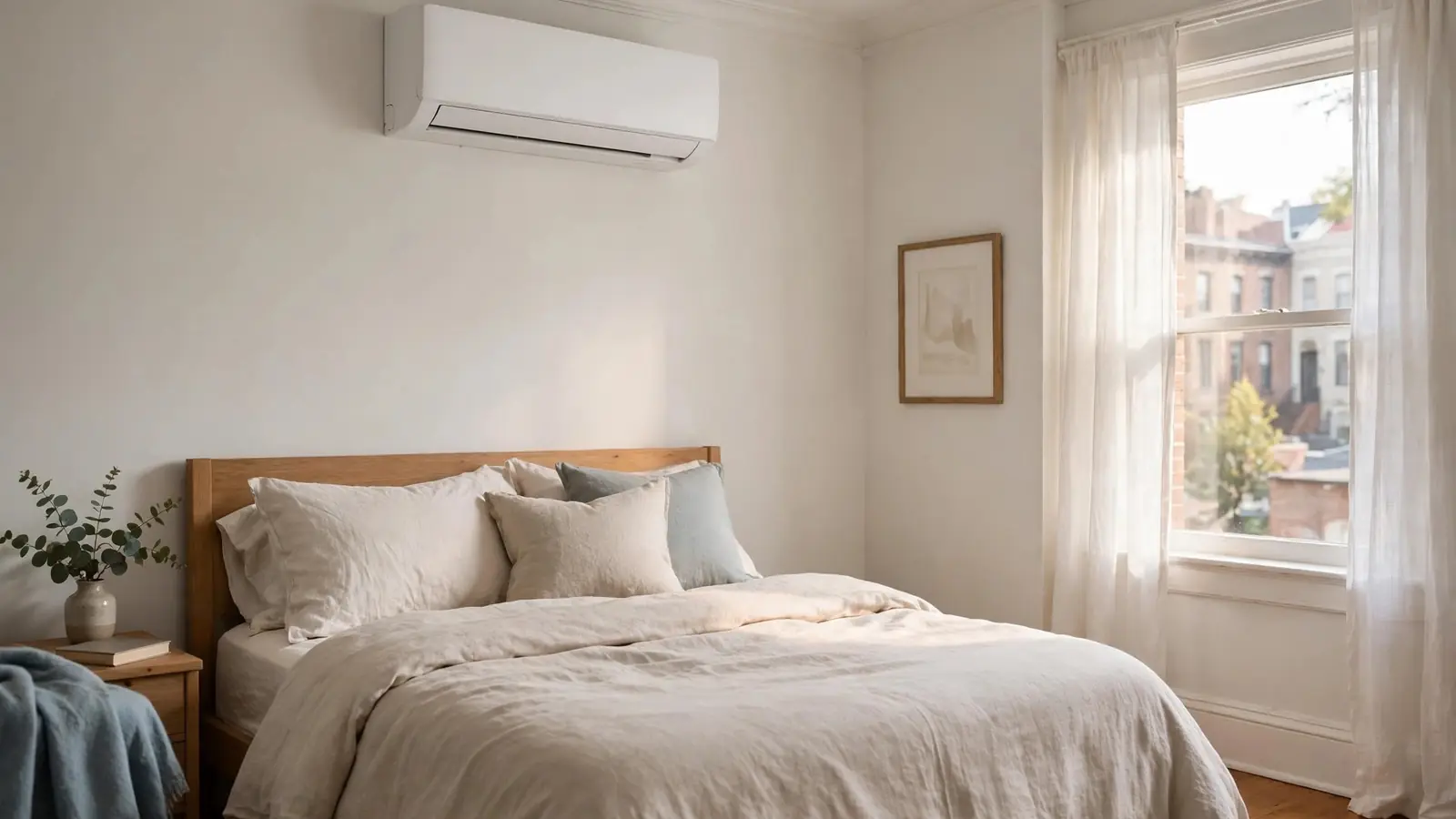
As older gas furnaces and boilers reach the end of their lives, many Capitol Hill owners switch to heat pumps, ducted or ductless, for both heating and cooling. Rowhouses with radiators may keep their boilers for heat and add mini-splits for cooling. Heat pump outdoor units on roofs must sit above snow and drain properly during winter defrost.
Climate
Summer on the Hill
Capitol Hill's tree-lined streets help, but dense blocks of brick and pavement still hold heat. On summer evenings, brick walls release heat stored during the day, and top floors under flat roofs stay warm long after sunset. Air conditioners here often run well into the night during heat waves. That long run time is when weak parts fail and slow refrigerant leaks finally show. A check in May, before the first 90-degree week, is worthwhile.
Ductwork
Ducts in rowhouses
Ducts in Capitol Hill rowhouses usually run in closets stacked floor above floor, in soffits along hallways, or through a top-floor crawl space with drops into rooms below. Return air is often limited to one or two grilles, which can restrict airflow. Leaky or uninsulated ducts in hot crawl spaces lose cooling before it reaches rooms. Technicians measure airflow and temperatures at registers and look for leaks, crushed flex duct and disconnected boots. Adding a return or sealing ducts can make a noticeable difference.
Comfort upgrades
Repair or upgrade options for rowhouse comfort
| Issue | Option |
|---|---|
| Hot top floor | Second system or mini-split for the top floor |
| Weak airflow | Add returns, seal ducts, clean coil |
| Clammy basement | Dedicated dehumidifier or mini-split |
| Noisy indoor unit | Check blower and duct sizing |
| Old R-22 system | Discuss replacement with heat pump options |
Maintenance
Annual care for a Capitol Hill system
- 1
Spring check
Before June heat: capacitor, refrigerant, coils.
- 2
Clear the roof unit
Leaves and debris from street trees.
- 3
Flush the drain
Especially for basement and attic air handlers.
- 4
Change filters
Monthly checks in summer.
- 5
Check line insulation
UV-damaged insulation on the roof.
- 6
Fall check for heat pumps
Defrost and backup heat.
Other house types
Frame houses and wider lots
Not every Capitol Hill home is a brick rowhouse. Some blocks have older frame houses, semi-detached houses and small apartment buildings. Frame houses may have attics with more room for air handlers and ducts, but also less insulation and more air leakage. Apartment buildings may use through-wall units or individual split systems with condensers on a shared roof. Tell the technician what kind of building you live in when you call.
Radiator homes
Radiators, boilers and adding cooling
Many Capitol Hill rowhouses still heat with hot-water or steam radiators fed by a basement boiler. These homes have no ducts at all. Adding cooling usually means either running new ducts through closets and chases to an air handler, installing a small-duct high-velocity system, or adding ductless mini-splits room by room. Mini-split heat pumps can also take over much of the heating, letting owners use the boiler less. Each approach has trade-offs in appearance, comfort and disruption.
Choosing help
Questions to ask a Capitol Hill technician
Have you worked on rooftop units here?
Roof access and protection take experience.
How will you find a leak in my long line set?
Detectors, pressure tests and access plans.
Do you service mini-splits?
Many renovations use them.
Are you licensed in DC?
Through the Department of Licensing and Consumer Protection.
Will any change need historic review?
Only if visible equipment or lines move.
Can you check my condensate pump?
Common in basement installations.
Commercial edges
Eastern Market, Barracks Row and commercial neighbors
Homes near Eastern Market, Barracks Row on 8th Street SE and H Street NE sit close to restaurants and shops with their own rooftop equipment. Commercial exhaust and kitchen grease can coat nearby condenser coils, and rooftop units on commercial buildings add heat and noise. If your condenser is near a restaurant exhaust, its coil may need cleaning more often.
Heat safety
Heat and health on the Hill
Capitol Hill has many older residents who have lived in their homes for decades. During heat waves, a failed air conditioner in a top-floor bedroom can become dangerous. Check on older neighbors, move to cooler rooms or lower floors, and use DC cooling centers when the District activates its heat emergency plan. The National Weather Service issues heat advisories for the Washington area when the heat index is expected to be dangerous.
Renovations
Renovations and the right time to upgrade
Capitol Hill houses are renovated often, from kitchen remodels to full gut renovations with new basements and roof decks. A renovation that opens walls and ceilings is the best chance to fix cooling problems: adding returns, resizing ducts, moving an air handler out of a cramped closet, installing a second system for the top floor, or switching to heat pumps. Involve the HVAC contractor early so ducts and line sets can be planned before drywall goes up, and cover returns and change filters during construction to keep dust out of the system.
Roof decks
Roof decks and equipment
Roof decks are popular on Capitol Hill, and they share space with condensers. Decks built over or around units can restrict airflow and make service difficult. Equipment should have clearance for air to flow and for technicians to work. If you are planning a deck, involve the HVAC contractor in the layout; moving a condenser may involve new lines and, if visible, historic review.
Summary
Capitol Hill AC at a glance
| Topic | What to know |
|---|---|
| Typical setup | Rooftop condenser, basement or top-floor air handler |
| Common issues | Line set leaks, roof heat, drain clogs |
| Access | Roof hatch; plan ahead |
| Historic rules | Keep equipment out of street view |
| Upgrades | Best done during renovations |
| Heat pumps | Increasingly common for heating and cooling |
Records
After a repair: what to keep
Keep notes from each service visit: what was found, what was replaced, refrigerant type and amount added, and readings after the repair. Note model and serial numbers from the outdoor and indoor units. In older rowhouses that change hands often, a clear record helps future owners and technicians understand systems that are hidden in closets and on roofs.
Older equipment
Older systems and refrigerant changes
Many Capitol Hill systems installed in the 1990s and 2000s still use R-22, which is no longer produced for servicing. Repairs remain possible with reclaimed refrigerant, but a major leak or compressor failure on an old R-22 system often leads owners to consider replacement. Newer systems use refrigerants being phased under federal HFC rules, and the newest use A2L refrigerants that require trained installers. A technician can tell you what your system uses.
Early signs
Signs your rowhouse system needs attention
- Top floor slower to cool each yearSlow leak or dirty coil.
- Outdoor unit louderFan motor bearings wearing.
- Musty smell from ventsDrain or coil moisture problem.
- Higher summer electric billsSystem working harder.
- Ice on basement linesAirflow or refrigerant issue.
Logistics
Parking, access and timing
Capitol Hill streets are narrow, with residential permit parking and busy commercial strips. Technicians carrying ladders, recovery tanks and replacement parts appreciate clear directions and, if possible, a place to park nearby. For rooftop work, plan for someone to be home to open the hatch. Large jobs such as condenser replacement may require a crane or hoist on rare occasions; the contractor will arrange any street permits needed.
Summary
Capitol Hill in short
Expect a rooftop condenser, a long line set and an air handler tucked into a basement, closet or top-floor crawl space. Keep the roof unit clean, the drain clear and the filter fresh. Watch for slowly weakening cooling, which often means a leak. Keep equipment out of street view in the historic district. And plan upgrades during renovations, when walls are open and ducts can be done right.
Eastern Hill
Lincoln Park and the eastern blocks
Toward Lincoln Park and beyond, blocks of rowhouses from the early twentieth century, many with front porches and small front yards, mix with corner stores and churches. Some of these homes have ground-level condensers in rear yards reached by alleys rather than rooftop units, which simplifies service. Alley access helps technicians, but units in alleys can collect trash and debris and may need protective cages.
FAQ
Capitol Hill AC questions
How do technicians reach my rooftop unit?
Usually through a roof hatch. Mention access when you call.
Why does the top floor of my rowhouse overheat?
Flat roofs absorb heat, and ducts to the top floor may be long or leaky.
Can I move my condenser to the front roof?
It may need historic review. Keeping it out of street view is simpler.
Why does my AC lose cooling every summer?
A slow leak in a long line set is a common cause.
Are mini-splits allowed in the historic district?
Indoor heads are fine; outdoor units should be placed out of street view.
Who handles AC in my basement apartment?
Usually the owner; tenants should report problems in writing.
Why is there water in my basement near the AC?
A clogged drain or failed condensate pump is likely.
Can my radiator house get central air?
Yes, with ducts in closets and chases or with ductless mini-splits.
Can my neighbor's condenser affect mine?
If they sit close, hot exhaust air can reduce efficiency. Placement matters.
Should I add a return grille?
If airflow is weak, more return air often helps. A technician can measure.
When should I schedule maintenance?
Spring, before the first heat wave, and fall for heat pumps.
Can a radiator-heated rowhouse get air conditioning?
Yes, with ducts in closets, high-velocity systems or ductless mini-splits.
Why does my condenser get dirty so fast?
Nearby restaurant exhaust, trees and roof debris can clog the coil.
What should I do if an older neighbor's AC fails in a heat wave?
Help them to a cooler place, offer water and call for help if they show signs of heat illness.
Can a roof deck block my AC?
Yes, if it restricts airflow or access. Plan clearance around the unit.
Is a renovation a good time to upgrade cooling?
Yes. Open walls make ducts and line sets much easier to install.
Who fixes AC in a Navy Yard condo building?
In-unit equipment is often the owner's; shared plants are the building's. Check your documents.
Is my 2000s-era system still repairable?
Usually, though R-22 systems face limited refrigerant supply.
Do I need to be home for a rooftop repair?
Usually, to open the roof hatch and give access.
Can a crane be needed to replace a roof condenser?
Occasionally for large units; most are carried up by hand.
Are condensers in alleys a problem?
They are easier to reach but collect debris; keep them clear and consider a protective cage.
Do all Capitol Hill homes have rooftop units?
No. Some have ground units in rear yards reached from alleys.
Is a ductless system quieter than a rooftop condenser?
Modern mini-split outdoor units are often quiet, especially inverter models at low speed.
Can trees over my roof cause AC problems?
Leaves and seeds clog condenser coils; clean them regularly.
Should I keep my old window units as backup?
Many owners do, but use them on proper outlets, not extension cords.
How long do rooftop condensers last?
Many last well over a decade, though heat and debris can shorten their life.