
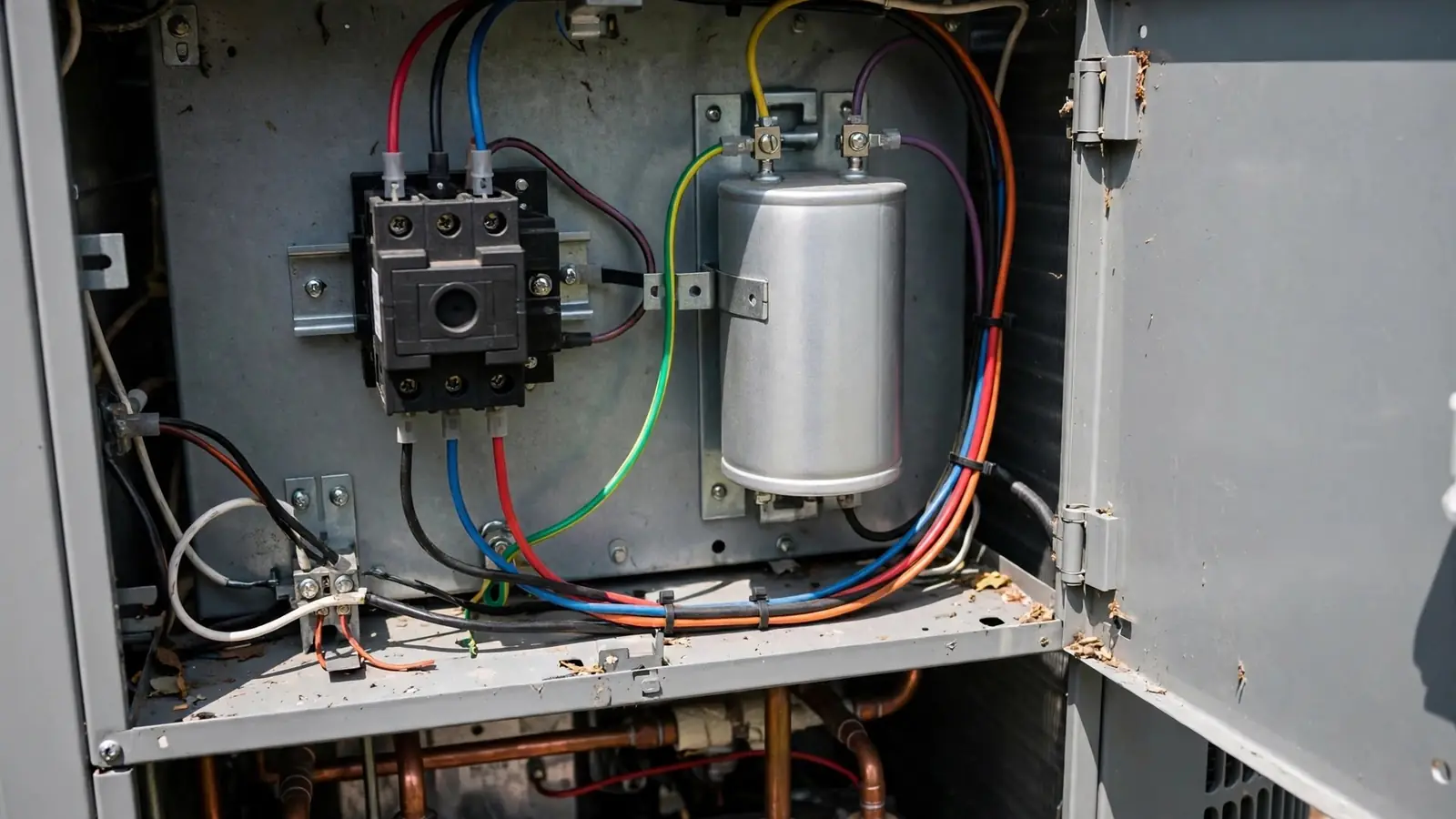
Key facts: Capacitor and Fan Repair
- A run capacitor stores energy to help the compressor and fan motors start and run [1].
- Heat shortens the life of capacitors, and DC summers bring long stretches of high temperatures [2].
- A failed condenser fan can cause the compressor to overheat and shut off.
- Capacitors can hold a dangerous electrical charge even when power is off.
- Replacement parts should match the specifications on the original part.
The part
What a capacitor does in your AC
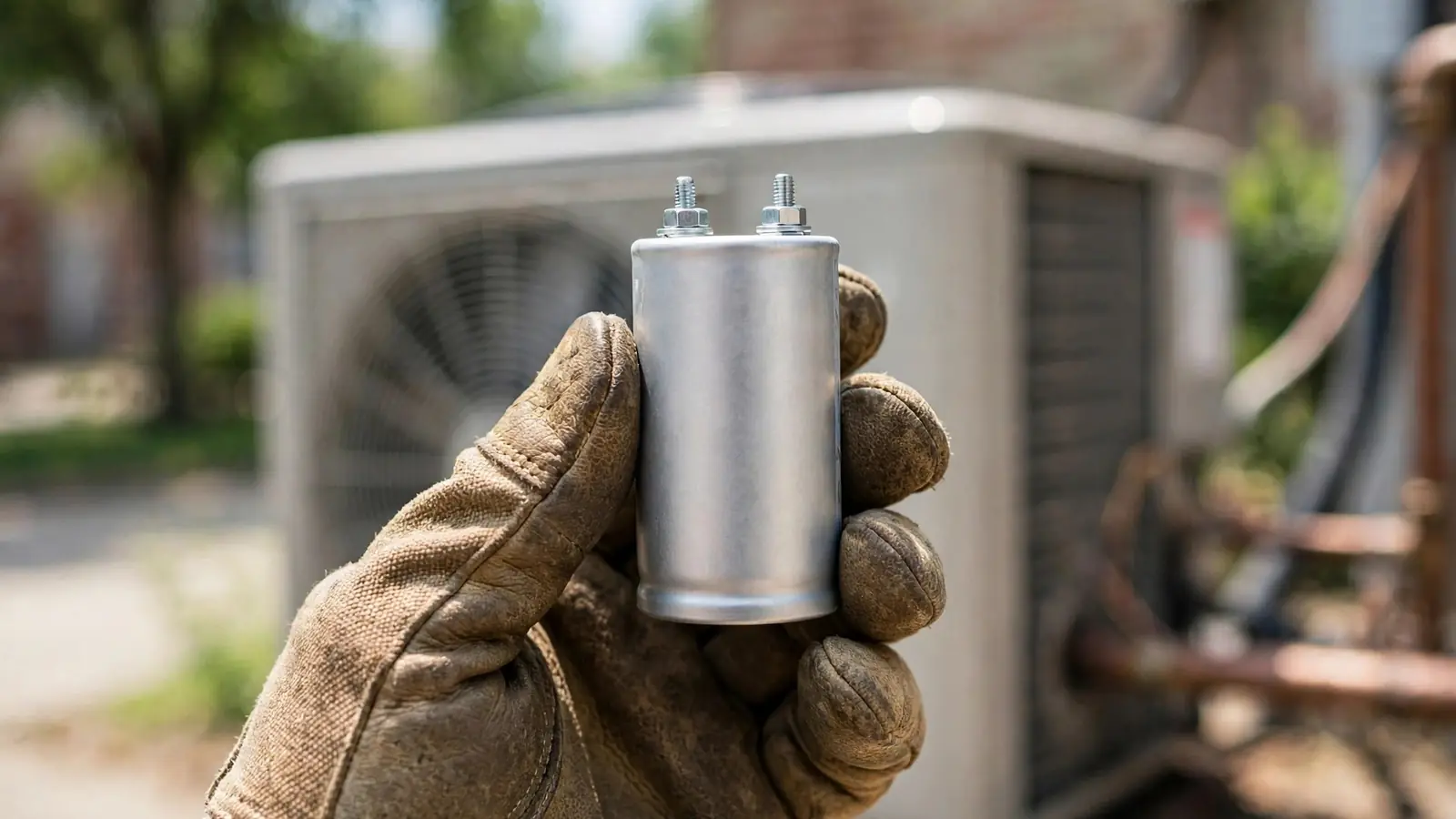
Inside the outdoor unit of a central air conditioner or heat pump is a small metal can, the run capacitor, often a dual capacitor serving both the compressor and the condenser fan motor. It stores and releases electrical energy to give these motors the push they need to start and to keep them running efficiently. Some systems also have a separate start capacitor or a hard-start kit to help an older compressor start.
When a capacitor weakens or fails, the motor it serves may hum without starting, start slowly, run hot or stop altogether. Because the compressor and fan depend on it, a failed capacitor can stop cooling entirely, even though the rest of the system is fine.
Signs
Signs of a capacitor or fan problem
Outdoor unit hums but fan does not spin
Classic sign of a failed fan capacitor or motor.
Fan spins slowly or stops
Weak capacitor or failing motor bearings.
Warm air indoors
The compressor is not running.
Clicking on and off
Compressor tries to start and fails.
Bulging or leaking capacitor
Visible swelling on top of the can.
Breaker tripping
A struggling motor draws too much current.
Diagnosis
What fails and what it looks like
| Part | Symptom | Usual repair |
|---|---|---|
| Run capacitor | Humming, fan or compressor will not start | Replace with matching rating |
| Condenser fan motor | Fan stopped or slow, hot motor smell | Replace motor, often with capacitor |
| Contactor | Unit will not start, or will not stop | Replace contactor |
| Start capacitor or hard-start kit | Compressor struggles to start | Replace or add |
| Wiring or terminals | Burned connections, intermittent running | Repair wiring |
| Compressor | Humming, tripping, overheating | Major repair or replacement decision |
Heat
Why DC heat is hard on capacitors
Capacitors are rated for a maximum operating temperature, and their lifespan falls as temperatures rise. A condenser on a black, flat rowhouse roof in July can sit in air far hotter than the street-level reading, with the sun beating on the cabinet. Long run times during heat waves add stress. Power fluctuations and lightning in summer storms can also damage capacitors.
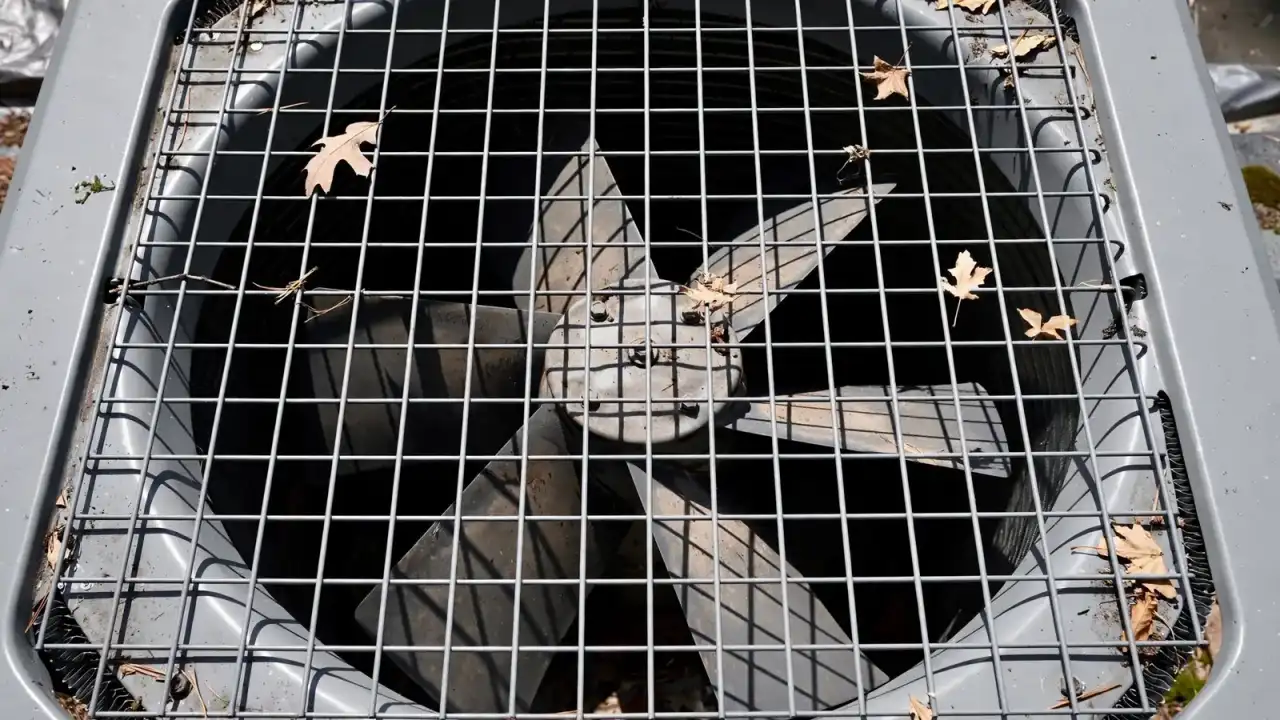
Condenser fan motors suffer in the same conditions. Their bearings wear, dirt and debris clog the coil around them, and they run hotter when airflow is restricted. When the fan stops, the compressor quickly overheats and shuts off on its internal protection, then tries again, which shortens its life.
The repair
What a technician does
Most capacitor and fan repairs are completed in a single visit when parts are available.
- 1
Switch off power and discharge
Safely disconnect and discharge the capacitor.
- 2
Test the capacitor
Measure microfarads against the rated value.
- 3
Test the fan motor
Check windings, bearings and amperage.
- 4
Check the contactor
Look for pitted or burned contacts.
- 5
Replace failed parts
Matching ratings for voltage and capacitance.
- 6
Run and measure
Confirm the fan, compressor and amperage are normal.
Rooftops
Rooftop condensers and fan failures
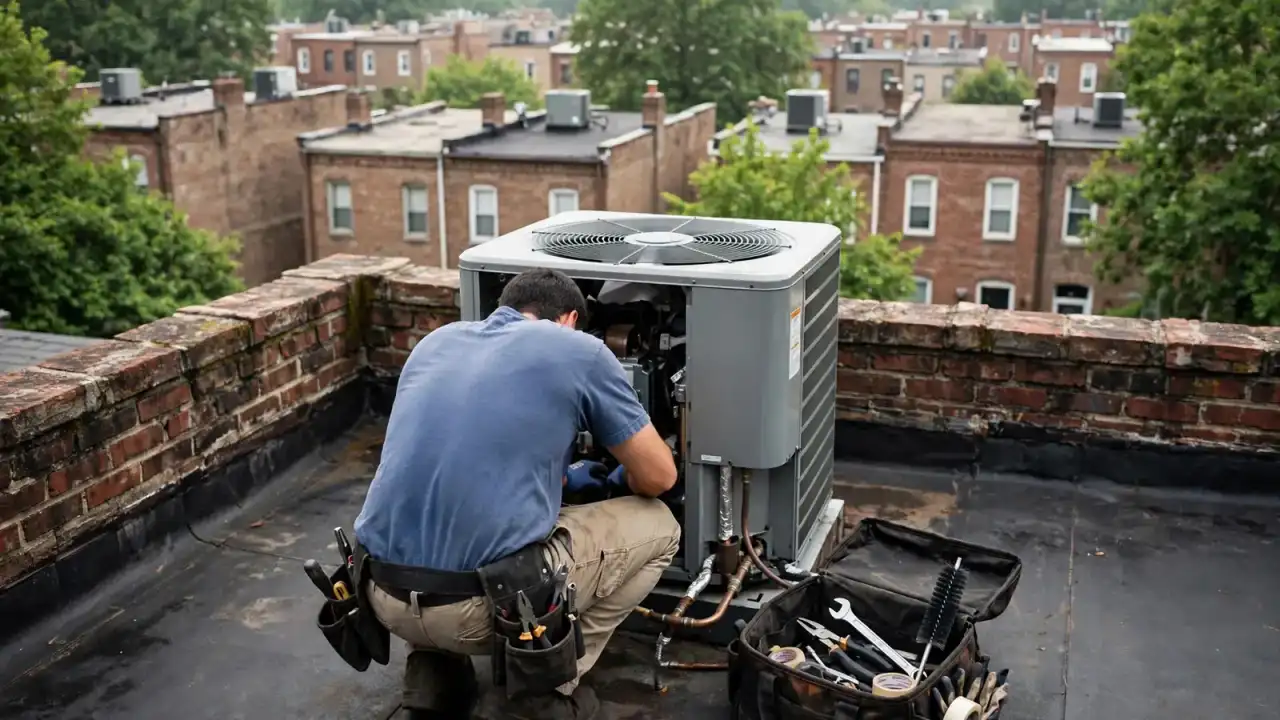
On DC rowhouses, many condensers live on the roof. Technicians need safe access, usually through a roof hatch, and replacement fan motors and capacitors have to be carried up. Debris such as leaves, seed fluff and plastic bags can jam or slow fans. Strong storms sometimes knock items into the fan guard.
Because rooftop units are out of sight, a stopped fan can go unnoticed until the house warms up. If you have a roof hatch and it is safe to look, check whether the fan is spinning when the system runs.
- Access through roof hatches
- Debris jams fans
- Full sun overheats parts
- Stopped fans go unnoticed
Contactors
Contactors and other outdoor electrical parts
The contactor is a switch that the thermostat controls through low-voltage wiring. When the thermostat calls for cooling, the contactor closes and sends full power to the compressor and fan. Over years, its contacts pit and burn, and insects or debris can get inside. A failed contactor may stop the unit from starting or, less often, stick closed so the unit runs constantly. Contactors are commonly replaced along with capacitors when they show wear.
Hard-start
Hard-start kits for older compressors
Older compressors can have trouble starting, especially on hot days or with weak power. A hard-start kit adds a start capacitor and relay to give extra starting torque. It can help an aging compressor start reliably, but it does not fix underlying problems such as a failing compressor or wrong refrigerant charge. A technician can measure starting current and advise whether a kit makes sense.
Options
Repair choices
| Situation | Typical approach |
|---|---|
| Capacitor tests weak, fan and compressor fine | Replace capacitor |
| Fan motor seized or bearings worn | Replace motor and capacitor |
| Contactor pitted | Replace contactor |
| Compressor hard to start | Check charge and wiring; consider hard-start kit |
| Compressor failed | Discuss repair or system replacement |
Prevention
Preventing capacitor and fan problems
Regular maintenance helps. During a spring check, technicians can test capacitors and catch weak ones before the first heat wave. Keeping the outdoor coil clean and the area around the unit clear helps the fan move air easily. Shading a ground-level condenser can help, as long as airflow is not blocked. Surge protection may reduce damage from power spikes during storms.
Dual capacitors
Dual capacitors explained
Many residential condensers use a dual run capacitor: one can with three terminals, typically marked for the compressor, the fan and a common connection. It has two ratings, such as 40/5 microfarads, one for each motor. If either section fails, the motor it serves will not run correctly. Technicians test each section separately. Replacements must match the ratings and have an equal or higher voltage rating. Installing the wrong capacitor can damage motors or shorten their life.
Fan motors
Fan motors and their bearings
The condenser fan motor sits on top of the outdoor unit and pulls air up through the coil. Over years, its bearings wear, especially in dirty or wet conditions. Early signs include squealing, grinding, a fan that takes a nudge to start in a technician's hands, or a motor that runs very hot. A failing motor often takes its capacitor with it, so the two are frequently replaced together. Modern replacement motors may be more efficient than originals.
Before you call
Checks you can do safely
Never reach into the unit or open the electrical panel.
- 1
Look from a safe distance
Is the outdoor fan turning when the system runs?
- 2
Listen
Humming, clicking or buzzing without the fan turning is a clue.
- 3
Check the breaker
Reset once if tripped; if it trips again, stop.
- 4
Check for debris
Leaves or objects on the fan guard can be removed with power off.
- 5
Turn the system off
If the fan is not turning, to protect the compressor.
Sounds
Typical outdoor unit sounds
| Sound | Possible cause |
|---|---|
| Steady humming, no fan | Failed capacitor or seized fan motor |
| Clicking every few minutes | Compressor trying to start and tripping on overload |
| Squealing or grinding | Worn fan motor bearings |
| Rattling | Loose panel, debris in the fan or a loose fan blade |
| Buzzing at the contactor | Pitted contacts or a weak coil |
| Loud bang then silence | Electrical failure; switch off and call |
Heat pumps
Heat pumps use the same parts
Heat pumps have the same capacitor, contactor and fan motor as air conditioners, plus a reversing valve and defrost controls. Because they run in winter as well as summer, their parts work more hours each year. A failed capacitor on a heat pump stops both heating and cooling, and in winter the system may fall back on electric backup heat, which keeps the house warm but uses more electricity. The same safety rules apply: do not open the unit yourself.
Compressor protection
What happens to the compressor when the fan stops
The compressor relies on the condenser fan to remove heat from the refrigerant. When the fan stops, pressure and temperature inside the system climb quickly. The compressor's internal overload switch opens to protect it, the compressor stops, cools, then tries again. Repeated cycles like this are hard on the compressor. That is why turning off a system with a stopped fan, and getting it fixed quickly, protects the most important part of your air conditioner.
Storms
Storms, surges and outdoor electrical parts
Summer thunderstorms are common in the Washington area, and lightning and power fluctuations can damage capacitors, contactors and control boards. After a storm, if your system will not start or the outdoor unit hums without running, a damaged capacitor is a likely cause. Pepco, the area's electric utility, manages the power grid; if you notice repeated flickers or outages, report them to the utility. A whole-house surge protector, installed by a licensed electrician, may reduce damage to sensitive equipment.
Ground units
Ground units in yards and alleys
Detached homes, end-unit rowhouses and homes with rear yards often have condensers at ground level, sometimes in narrow side yards or by the alley. These collect leaves, grass clippings and trash, and shrubs or fences can crowd them. Dryer vents blowing lint at the coil are another common problem. Restricted airflow makes the fan motor work harder and the compressor run hotter. Keep at least a couple of feet clear around the unit and trim plants back.
Care
Habits that help outdoor parts last
- Spring checkTest capacitors before peak season.
- Clean coilGently rinse with power off; avoid bending fins.
- Clear spaceKeep plants, fences and storage away.
- Mind the roofCheck rooftop units after storms if safe.
- Do not cover in summerCovers trap heat and moisture.
- Surge protectionAsk an electrician about options.
Rooftop repairs
Rooftop unit repair, step by step
- 1
Arrange access
Roof hatch, ladder or building management.
- 2
Make the roof area safe
Check footing and roofing condition.
- 3
Disconnect and discharge
Safety first before touching parts.
- 4
Diagnose and replace
Capacitor, fan motor or contactor.
- 5
Protect the roof
Avoid damage to roofing when moving parts.
- 6
Test and clean up
Run the system and remove old parts.
Compressor
When the problem is the compressor
Sometimes a humming outdoor unit points not to the capacitor but to the compressor itself: a seized compressor, a shorted winding or a locked rotor. Technicians check winding resistance, current draw and whether the compressor starts with a known-good capacitor. A failed compressor is a major repair. On older systems, especially those using R-22, owners often weigh compressor replacement against a new system. A technician can explain the situation and options; the decision is yours.
Indoor blower
Indoor blower motors and capacitors
The indoor air handler or furnace has its own blower motor, and older permanent split capacitor (PSC) blower motors also use a capacitor. If the indoor blower fails, the outdoor unit may run but no air moves through the house, and the indoor coil can freeze. Newer systems often use electronically commutated motors (ECMs), which are more efficient and do not use a run capacitor but have their own control modules. A technician checks the indoor blower whenever airflow is weak or absent.
Parts
Parts availability in summer
Capacitors and common contactors are widely stocked, and technicians often carry them. Condenser fan motors come in many sizes and shaft types; universal motors fit many units, but some systems need exact replacements that may take time to source during peak season. If a part needs to be ordered, ask about temporary options, such as fans or portable units, and the expected timeline.
Summary
Capacitor and fan problems at a glance
| Topic | What to know |
|---|---|
| Most common failure | Run capacitor, especially in heat waves |
| Warning sign | Humming outdoor unit with fan stopped |
| Safety | Never open the unit; capacitors hold a charge |
| Compressor risk | Turn off the system if the fan is stopped |
| Rooftop units | Plan access for the technician |
| Prevention | Spring testing and clean coils |
Repeated failures
Older systems and repeated failures
If capacitors fail repeatedly on the same unit, there may be an underlying cause: a fan motor drawing too much current, a compressor that is hard to start, high outdoor temperatures from poor airflow, voltage problems, or a capacitor with the wrong rating. A technician should look beyond replacing the part again. Measuring voltage, amperage and temperatures under load usually reveals the cause.
Waiting
Staying comfortable until the repair
A failed capacitor often happens on the hottest day of the year. While you wait, close blinds, run ceiling and portable fans, keep to the lowest and shadiest rooms, and drink water. Check on older relatives and neighbors. If anyone in the home is vulnerable to heat, consider going to a cooled public place or a DC cooling center during heat emergencies. Do not keep restarting the air conditioner in the hope it will start; repeated attempts can damage the compressor.
Choosing help
Choosing a technician for electrical repairs
Outdoor unit electrical repairs involve high voltage and should be done by trained HVAC technicians. In DC, ask about licensing through the Department of Licensing and Consumer Protection and about insurance. Ask what parts are being replaced and why, and ask to see the old part if you want. A good technician explains the readings that led to the diagnosis.
Other causes
Signs it is not the capacitor
- Thermostat blankPower or control problem indoors.
- Indoor fan not running eitherBlower, control board or power issue.
- Breaker trips instantlyShort circuit or compressor fault.
- Fan runs, compressor silent, no humContactor or wiring issue.
- Water near the indoor unit and no coolingCondensate safety switch may have tripped.
Inverters
Mini-splits and inverter systems
Ductless mini-splits and many newer high-efficiency systems use inverter-driven compressors and fan motors controlled by electronic boards rather than traditional capacitors and contactors. When they fail, the outdoor unit may flash an error code instead of humming. Diagnosis involves reading those codes and testing boards, sensors and motors. The same safety rule applies: leave the electrical work to a qualified technician.
FAQ
Capacitor and fan questions
Why does my outdoor unit hum but the fan does not spin?
Often a failed capacitor or fan motor. Turn the system off and call a technician.
Can I replace a capacitor myself?
It is dangerous. Capacitors hold a charge that can cause serious injury.
How long do capacitors last?
Many last several years, but heat and power surges shorten their life.
Is it safe to keep running the AC with the fan stopped?
No. The compressor can overheat and be damaged.
Why did my AC fail during a heat wave?
Heat and long run times stress capacitors and fan motors.
Does a bulging capacitor need replacing?
Yes. Swelling means it has failed or is failing.
What is a contactor?
A switch that sends power to the compressor and fan when the thermostat calls for cooling.
Will a hard-start kit fix my old compressor?
It can help it start, but it will not fix a failing compressor.
Do heat pumps have the same parts?
Yes, plus extra controls for heating and defrost.
Can storms damage AC capacitors?
Power surges from storms and lightning can.
What does the rating on a capacitor mean?
It shows capacitance in microfarads and voltage. Replacements must match.
Why do capacitors and fan motors often fail together?
A failing motor strains its capacitor, and vice versa.
Does a heat pump capacitor failure affect heating?
Yes. Both heating and cooling stop until it is replaced.
Should I cover my outdoor unit?
Not in summer. Covers trap heat and moisture. Some owners cover the top only in winter.
Can a lightning storm damage my AC?
Yes. Surges can damage capacitors, contactors and control boards.
How do I know if the compressor has failed?
A technician can test it. Humming and tripping can point to a compressor problem.
Why does my capacitor keep failing?
There may be an underlying cause such as a failing motor, high heat or voltage issues.
Do newer blower motors use capacitors?
Many newer ECM blower motors do not, though older PSC motors do.
Should I keep resetting my AC if it hums?
No. Repeated attempts can damage the compressor. Turn it off and call.
Can I see the old part after the repair?
Ask the technician; many are happy to show you.
Do mini-splits have capacitors?
Many use inverter boards instead. Failures often show as error codes.
Can a dirty coil cause the fan motor to fail?
Yes. Restricted airflow makes the motor run hotter and wear faster.
Is a squealing outdoor fan urgent?
It often means worn bearings. Have it checked before the motor seizes.